Why
monogamy arises
In the polygamy
part, the actions of buyers and sellers naturally move sex-service markets
toward the equilibrium of supply and demand. Thus, the activities of the many
buyers and sellers automatically push the market price toward the equilibrium
price. Once the market reaches its equilibrium, all buyers and sellers are
satisfied, and there is no upward or downward pressure on the price. But like I
said before the essence of market economy is to kick unqualified buyers and unqualified
sellers out of the market. There are still poor people there, who can't afford
the equilibrium price. What would happen if there are many buyers who can't
afford the equilibrium price? Why did war massacre gradually disappear in human
history? Don't tell me it's because people love peace, the stupid. Why do
humans choose to live in groups? If animals live together in groups their genes
must get more benefit out of the association than they put in. The evolution in
itself has no place for cooperative interactions. There is no altruism here,
only selfish exploitation by each individual of every other individual.
Similarly, with the division of labor and trade, top men need more and more goods
and services provided by bottom men otherwise they must choose to kill the
bottom men instead of letting them alive. In other words, with the expansion of
transaction civilization and the development of capitalism, the ruler and the
lower males gradually formed a parasitic relationship. We can also view this as
a classical application of the idea of 'cruel bind'. Of course, this is also a
price. The price, for the male ruler, is to give up some women's right to use,
on the surface at least, because we can view the sex satisfaction as a
necessity for men's living. In other words, with the division of labor, the
bottom males gave me more and more social values which are more useful than extra
women were to me. What would the mass do if without sex satisfaction? Resorting
to violence civilization. So, the deal was made between men because trade can
make both better off, contract civilization through purchase limit had to compromise
violence civilization once again. Apparently, who is going to be the loser and who
is going to be the beneficiary of the purchase limit?
I can assert that monogamy
also arose in the revolt, at least recessive revolt. Let me make up a story,
maybe real story. The power of a good story is that it dispels common
confusions. With the division of labor and trade, men increasingly depend on
each other economically, so massacre gradually disappeared, more and more bottom
men can survive in the society, and we can regard this progress as a spread of
survival rights. Just because of this spread of survival rights, women are formally
into devaluation cycle. Here you may be confused by my saying, and definitely
believe that how wonderful peace is, but the opposite is the truth, because
this spread is result of lowering of standards, and lowering of standards
must cause chaos. Do you remember that the most notorious incident took place
during 2016 year's New Year's Eve celebrations in Cologne, where wide-scale
sexual assaults took place? Why? What are root causes of this crime? It is easy
to answer: lowering standard of survival rights or excessively spread of
survival rights. All troubles in humans start with this reason. I will talk
about my opinion about the problems Westerner facing later, now let's go back
to monogamy. As sex satisfaction is almost living necessities, at least for me,
it means when men have survival rights already, they are not satisfied with just
survival rights, and then they ask for mating rights. Lots of men at the bottom
of society, who can't afford the equilibrium price of a woman in polygamy, organized
violent revolts against the men who at the top of the society. In Microeconomics,
for some goods, however, one person's demand also depends on the demands of
other people. In particular, a person's demand may be affected by the number of
other people who have purchased the good. If this is the case, there exists externality.
Apparently, woman-consuming has this property, because sex ratio has been designed
to 1:1 by God, if a man has 10 wives, it means 9 men can't have a woman. At
last, after weighing all pros and cons, the top men chose to compromise for
their own interests, because life is much more valuable than extra sex-service,
and they abolished polygamy and established monogamy, and women could be used
as a bargaining chip to exchange the social stability. In short, the bottom men,
as The Luddite Revolt, kidnapped top men using “cruel bind” idea, and polygamy was
the placebos to pacify the bottom men and women became comfort women. As a
result, polygamy was practiced. Engels said that the marriage system is to
ensure that every man has his own slaves. To be precise, monogamy can guarantee
that every man has his own slaves and polygamy cannot.
How Supply-demand curves shift in the change from polygamy to monogamy
What about
other buyers who can't afford the equilibrium price in free market? What if
this product or service is necessities? How does the government use policies to
satisfy them? To be honest, purchase restriction is a not common means because
authorities usually choose price control and taxes to intervened in the free
market. The policy makers
sometimes restrict free trade is by putting limits on how much of a good can be
bought. What is the nature of monogamy? Sex service purchasing limitations. To
see why, consider an analogy. Ferrari cars are regarded the most expensive cars
in the world, and one day all governments join together and make an announcement:
Each person can only buy a Ferrari car, the second car is forbidden. What would
happen next? After the words like “son of bitch”, what would the company
of Ferrari choose to do as a counter-strategy? First, in short-run Ferrari
choose mark-down sale to clear inventory; second, in long-run they must choose reduction
of cars and exit the market. Restriction is a common means to pander to the
public in history. In a planned economy such as that of Cuba,
North Korea, or the former Soviet Union, these allocation decisions are made mostly
by the government. To be honest, monogamy is a kind of planned economic policy,
instead of market economy.
Similarly,
let's examine how supply-demand curves shift in the change from polygamy to monogamy.
As same as other economic problem, when analyzing how some event affects the
equilibrium in a market, we proceed in three steps. First, we decide whether
the event shifts the supply curve, the demand curve, or, in some cases, both
curves. Second, we decide whether the curve shifts to the right or to the left.
Third, we use the supply-and-demand diagram to compare the initial and the new
equilibrium.
(1) We can
see Figure 2.1 and suppose the market for girls begins in a long-run
equilibrium under both patriarchy and polygamy. Fathers are earning zero
profit, so price equals the minimum of average total cost. The long-run
equilibrium is point A, the quantity sold in the market is Q1, and the
price is P1 as shown in following figure (a) in initial condition. In
panel (a), each father makes zero profit, and so there is no incentive for old father
to exit the market or for new father to enter.
(2) When some
event shifts one of these curves, the equilibrium in the market changes,
resulting in a new price and a new quantity exchanged between buyers and
sellers. The essence of monogamy is the restriction policy of sex service purchasing.
At any given price, buyers would now only purchase one woman at one time, and any
change that reduces the quantity demanded at every price shifts the demand
curve to the left. In other words, the demand curve shifts to the left and the supply
curve remains the same. An event that reduces quantity demanded at any given price
shifts the supply curve to the left. The equilibrium price falls, and the
equilibrium quantity falls as well. Panel (b) shows what happens in the short
run when demand falls from D1 to D2. The equilibrium goes
from point A to point B, price falls from P1 to P2, and
the quantity sold in the market falls from Q1 to Q2. What
should a rational father do as counter-strategy in short-run? As same as Ferrari,
because girls-producing is a long cycle with some sunk cost already, father can
enter and exit in the long run but not in the short run, the response of a
market to a change in demand depends on the time horizon. Even we can say that
in a very short-run, the supply curve is vertical without any elasticity,
because fathers can't kill a grown-up girl and recover the sunk cost, and
anything is better than nothing, so father chooses to sell girls at a loss as a
short counter-strategy.
(3) What will father do as counter-strategy in long-run? During panel (b), because price is lower than average total cost, fathers suffer losses, which over time encourage old fathers to exit the market. This exit shifts the short-run supply curve to the left from S1 to S2, as shown in panel (c). In the new long-run equilibrium, point C, price has returned to P1 but the quantity sold has decreased to Q3. Losses are again zero, price is back to the minimum of average total cost, but the market has fewer fathers to satisfy the greater smaller demand.

Let's compare the initial
and the new equilibrium: point A and point C. Apparently the price of point C
is as same as that of point A, but the quantity of point C is drastically
reduced a lot compared with point A. You will find an interesting result that the
new equilibrium is contrary to the intention of policymakers, and less and less
girls are in the market, and more and more men can't marry a girl even in monogamy.
Why is that? Let's review some characteristics of a competitive market: first,
there are many buyers and many sellers in the market; second, the goods offered
by the various sellers are largely the same; third, firms can freely enter or
exit the market. As a result of these conditions, the actions of any single
buyer or seller in the market have a negligible impact on the market price.
Each buyer and seller take the market price as given. Here I want to address
the third one: free entry and exit. Because self-interested fathers, who don't
care about supply quantity at all in the market but only profit maximization, can
exit more easily in the long run than in the short run, the long-run supply
curve is typically more elastic than the short-run supply curve, because in
girls-production industry variable costs are far greater than fixed costs, and
even we can say that there is almost no fixed costs, so shortly after monogamy
arises, if still under patriarchy fathers must choose to exit supply market as
soon as possible. This is the charm of the competitive market: if there is free
entry and exit in a competitive market, it is a powerful force shaping the
long-run equilibrium. In the first round of sexes game, from the perspective of
individual, women become dominated strategy. What is going on after the cabal's plot
failed? Bingo, a series of conspiracies follow up: disintegrate patriarchy to
oppose sex-selective abortion. So far, the sellers of the sex-trade are always
selfish and shrewd fathers, so they are bound to choose to kill the baby girls in
order to withdraw from the supply side of the sex-service as their counter-strategy
for the change from Polygamy to Monogamy. The authorities legislate against sex-selective
abortion under the banner of human rights. Girls born in low caste in India are
doomed to misfortune from birth. Why do the authorities insist on banning sex
selection? For their benefit? Definitely not! They need comfort women to
maintain stability. Let the weak be more unfortunate!
The collapse of patriarchy
Disintegration
of patriarchy can be regarded as the second conspiracy if we regard the polygamy
replaced by monogamy as the first conspiracy. Feminism replaced patriarchy. Don't
flatter yourself woman! Monogamy is definitely not the result of Feminism but
the equalitarianism spreading among men by pushing women into a more miserable
situation. Policymakers adopt two steps to achieve the goal of disintegrating patriarchy.
First step is prohibition of Sex-Selection Abortion; and second step is empowering
women the right of abusing freedom of mating.
Simply speaking, Sex-Selection Abortion is the most direct
counter-strategy by fathers in response to monogamy. I wonder if there is a sex
preference in animals? Here I want to share an idea written in The Selfish Gene by Richard Dawkins:
The problem of how many males and how many females are born
is a special case of a problem in parental strategy. Just as we discussed the
optimal family size for an individual parent trying to maximize her gene survival,
we can also discuss the optimal sex ratio. Is it better to entrust your
precious genes to sons or to daughters? Suppose a mother invested all her
resources in sons, and therefore had none left to invest in daughters: would
she on average contribute more to the gene pool of the future than a rival
mother who invested in daughters? Do genes for preferring sons become more or
less numerous than genes for preferring daughters?... In mammals, sex is
determined genetically as follows. All eggs are capable of developing into
either a male or a female. It is the sperms that carry the sex-determining
chromosomes. Half the sperms produced by a man are female-producing, or
X-sperms, and half are male-producing, or Y-sperms. The two sorts of sperms
look alike. They differ with respect to one chromosome only. A gene for making
a father have nothing but daughters could achieve its object by making him
manufacture nothing but X-sperms. A gene for making a mother have nothing but
daughters could work by making her secrete a selective spermicide, or by making
her abort male embryos…. Suppose that in the elephant seals mentioned above, a
mutant gene arose that tended to make parents have mostly daughters. Since
there is no shortage of males in the population, the daughters would have no
trouble finding mates, and the daughter-manufacturing gene could spread. The
sex ratio in the population might then start to shift towards a surplus of
females. From the point of view of the good of the species, this would be all
right, because just a few males are quite capable of providing all the sperms
needed for even a huge surplus of females, as we have seen. Superficially,
therefore, we might expect the daughter-producing gene to go on spreading until
the sex ratio was so unbalanced that the few remaining males, working flat out,
could just manage. But now, think what an enormous genetic advantage is enjoyed
by those few parents who have sons. Anyone who invests in a son has a very good
chance of being the grandparent of hundreds of seals. Those who are producing
nothing but daughters are assured of a safe few grandchildren, but this is
nothing compared to the glorious genetic possibilities that open up before
anyone specializing in sons. Therefore genes for producing sons will tend to become
more numerous, and the pendulum will swing back…. For simplicity I have talked
in terms of a pendulum swing. In practice the pendulum would never have been
allowed to swing that far in the direction of female domination, because the
pressure to have sons would have started to push it back as soon as the sex
ratio became unequal. The strategy of producing equal numbers of sons and
daughters is an evolutionarily stable strategy, in the sense that any gene for
departing from it makes a net loss…. By investing more food in a son and making
him big and strong, a parent might increase his chances of winning the supreme
prize of a harem. But this is a special case. Normally the amount invested in
each son will roughly equal the amount invested in each daughter, and the sex
ratio, in terms of numbers, is usually one to one.
It is clear,
that in long-run there is no sex preferences during non-human animals, but why only
human have sex preferences? In a word, we are now in inequilibrium state where
pendulum swings to one end. We can regard two strategies of sexes as just
opposite reproductive strategies (Female is bond, male is stock), because of
different endowments. One principle of The Game Theory: If I am using a mixed
strategy as a best response, it must be the case that each one is itself best. So,
it is completely analogous. God also faces a trade-off between risk and return
during genes investment, and apparently as a result he chooses a mixed strategy
set: female and male. Why? Because the two must be equivalent. Suppose God
wants to make portfolio investment in two assets: bonds, which are female with
low return and low risk, and stocks which are male with high return and high
risk. Female is a conservative strategy, which places a limit on the number of
children a female can have but female easily have a baby in her life, and male
is aggressive strategy, which places virtually unlimited on the number of
children a male can have, but only very few males have the opportunity to have
lots of offspring. Apparently, God is neutral in breeding female or male under
polygamy in a mixed strategy set. To take an extreme example, in one study of
elephant seals, 4% of the males accounted for 88% of all the copulations
observed. When polygamy was replaced by monogamy, it means each male has
reproductive rights as same as female. Now female is still with low return and
low risk, but male's situation has changed by the monogamy with high return and
low risk. Monogamy changed the original equilibrium. The two are not equivalent
in a mixed strategy set. Strategy of rearing boy strictly dominates strategy
rearing girl, because my payoffs from rearing boy is strictly greater than that
from rearing girl, regardless of what others do. In other words, and females
become strictly dominated strategy, and males become strictly dominant strategy
after the change from polygamy to monogamy. At the beginning of Monogamy,
anyone who invests in a son has a very good chance of being the grandparent of
hundreds of survival machines, so the strategy of investing in sons becomes an
evolutionarily stable strategy, in the sense that any gene for departing from
it makes a net loss. The essence of Sex-Selection Abortion is to cut the losses,
while the essence of prohibition of Sex-Selection Abortion is to keep you on a net
loss. In my eyes, there is no essential difference between killing a fetus and
killing a baby girl, and on the contrary, in the period of pregnancy,
B-ultrasound can help you cut the losses as soon as possible. One principle of
Economics: people only respond to incentives. An incentive is something that
induces a person to act, such as the prospect of a punishment or a reward.
Because rational people make decisions by comparing costs and benefits, they respond
to incentives. You will see that incentives play a central role in the study of
economics. One economist went so far as to suggest that the entire field could
be simply summarized: “People respond to incentives. The rest is commentary.” If the policy changes incentives, it will cause people to alter
their behavior. In the second round of sexes game, from the genetic
perspective, women become dominated strategy as well.
What would
happen next? Do you remember Lesson 1 from the open course from Yale The Game
Theory? Do not play a strictly dominated strategy. Arbitrage arises. People can
make an arbitrage profit by choosing dominant strategy and abandoning strictly dominated
strategy. Boys preference is a rational choice. The decisions of these households
are distorted by monogamy, but they are not doing wrong, because they just make
arbitrage under monogamy. At the same time, the unscrupulous who do the
business about B-scan are not wrong, because where there is a demand, there is
a supply. There is no-arbitrage in equilibrium state, and we can say we are in
pseudo-equilibrium when there is arbitrage. Rational people can make profit for
sure by arbitrage, if there people are rational they are not going to allow for
an arbitrage, but the vested interests group must prevent others from pursuing arbitrage
to maintain their own interests. Some people consider engaging in Sex
Identification by B-scan, called illegal activity by Chinese government, when
the government tries to maintain the pseudo-equilibrium in order to keep
stability. Economists call this the underground economy. These potential
criminals compare what they lose right now by breaking the law with what they
will lose in further illegally. In short, monogamy leads to Sex-Selection Abortion;
sex-selection abortion is just the counter-strategy in
response to monogamy by rational father. This is the most important insight. Abortion of female infants is
more pronounced in India. Recently I saw a news: As per recent official data,
not a single girl child was born in 132 villages of the district in the past
three months in India. Incidentally, 216 children were born in the region during
the same period. The only reason why the government has to step in and prevent sex-selective
abortions is that the absence of women can lead to men having no wives, but just
under the guise of bullshit human rights and justice. O justice! O justice! What
crimes are committed in your name! A curious aspect of the justice is that
everybody thinks he understands it, even just an actor. The pursuit of so-called
justice has been distorted as the patron saint of their intervention in the
market. In fact, pursuing arbitrage in Finance, and choosing strictly dominant
strategy in Game Theory and free entry and exit in microeconomics are unified. The
true intention of the Abortion ban is to keep free prostitutes in sex-service market
in order to pander to the lowest men. You realize if people are rational, they
are going to see through all that complicated stuff. It is a simple concept
which human haven't to grasp. In short, monogamy distort people's incentives,
and cause people to alter their choices, and lead to son preference.

Above Figure
2.2 presents the prohibition of sex-selection abortion. Like I said before in
very short-run, supply of girls is completely inelastic. Monogamy shifts the
demand curve to the left, and cross the supply at Point B with lower price PB.
As a rational response, fathers choose to sex-selection abortion, and refuse to
produce girls. With fathers gradually exit the market, the supply curve rotates
from vertical to horizontal, and exit raises the price of girl results in a movement
along the demand curve from Point B to Point E through Point C and Point D, and
the quantity of women in the market falls from Q1 to QE. But
QE is much smaller than Q1, which is the opposite of real intentions
of policymakers, as a result they make a ban law to prohibit Sex-Selection
Abortion aimed at keeping enough sex slaves in the market. So now fathers lose the
right to exit the sex-service as suppliers. To maintain stable quantities, the
government must maintain strict control over the girls' supply. This is the
first step of disintegrating patriarchy, but there are still some poor guys
there who can't afford the price of Point B. Have you notice that D2
and horizontal axis intersect at Point F? What dose Point F mean? QF
is the sum of men in society. QF-Q1 is the quantity of
men who still can't afford PB. In the real thing, the sex demand curve bowed inward to original point, and it means QF-Q1 is much bigger
than you see in above Figure 2.2. They are still unstable factors. How to do
about giving each of them a sex slave? Introducing virtual axis to disintegrates
patriarchy further.
Second step is empowering women the right of abusing freedom of mating. Feminism
blossoms everywhere against patriarchy under the purpose that is to deprive the
fathers of control over their girls, i.e., deprive the producers of control over
their goods. In other words, conspirators tried to replace the rational, selfish
and shrewd fathers with the irrational, ignorant and naive girls as the sellers
in sex-service market. Now irrational and naive girls, without any experiences
of sinister society or any bargaining experiences, are put on the sellers on trading
platform. There's nothing better than using ignorant and stupid girls for free
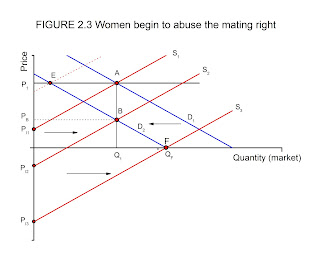
sex-service. As shown in the following Figure 2.3, notice
here: supply curve (S1) has a positive intercept in the Y-axis
under patriarchy and polygamy, and it means the cost of rearing a girl, so under
patriarchy a rational father can't accept his girl to offer free sex-service,
because he bears the cost of living to raise a girl, but his girl doesn't. Next,
prohibition of Sex-Selection Abortion force S1 to move to
the right aimed at keeping the same amount of women in the market. At this time
father is doomed to suffer a loss (P1-PB) if he has
a baby girl, but it is not enough, and conspiracy continues. What kind of stratagem
can move the supply curve (S2) go on moving to the right? What kind
of gimmick can make D2 and S3 intersect at the Point F
where the price is equal to Zero and QF is equal to the mount of men
in society? In other word, what can make women, as new sellers, willing to
provide sex-service to men for free? Lies arise. Lies are abhorrent, but also
useful. Strictly speaking, introducing imaginary number arises, but in my view,
there is no much difference between the two. Apparently, lie, I mean here, is
Love, because girls are impractical, unrealistic, fantastic, irrational, unreasonable,
imaginative, insane, half-baked and illogical. You can see how many words I have
found in English for girls, which fit girls very well. Love is born like this
under such an evil intention. As they wish, love drives the S2 to
the right. At point F, each man has a woman for free, and the deal runs like
this: man gives up his love to get free sex service from woman, and woman gives
up her sex to get love from men. What a good deal for men, and what a bad deal
for women. Of course, this ideal and Utopian model made by shameless government is doomed to
work in short-run but fail in long-run. “What has always made the state a hell on earth has been precisely that man has tried to make it heaven.” Said by Friedrich Hölderlin.
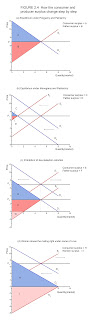
Let's check the consumer and producer surplus before and after the change
as shown in following Figure 2.4. For simplicity, I use the same scale. In
panel (a), it represents consumer surplus and producer surplus in equilibrium
under both polygamy and patriarchy.
In this scenario, consumer surplus is equal to
the area of A: A=5*5/2=12.5Producer (Father) surplus
is equal to area of B: B=5*5/2=12.5
The total area between the supply and demand curves up to the point of
equilibrium represents the total surplus in this market. Totalsurplus=A+B=25 . Free markets produce the quantity of goods that maximizes
the sum of consumer and producer surplus.
In panel (b), it represents consumer surplus and producer surplus in equilibrium
under both monogamy and patriarchy. Apparently you can find that both are very
small, because rational fathers would choose exit the girls-produce industry as
counter-strategy to shift supply curve to the left after monogamy shifting the demand
curve to the left.
In this scenario, consumer surplus is equal to the area of C: C=1*1/2=0.5
Producer (Father) surplus is equal to area of D: D=1*1/2=0.5
Totalsurplus=C+D=1. The price is the same one, and men, who can afford this
price, is also the same men, but the only difference is that
each man only can buy a girl once. Obviously, this result is the opposite of
policymaker's intention.
In panel (c), it represents consumer surplus and producer surplus in prohibition
of exit the market. Fathers are forced to keep the quantity as same as in polygamy.
In this scenario, consumer surplus is equal to the area of E: E=5*5/2=12.5
Producer (Father) surplus is equal to area of F: F=5*5/2-G=12.5-2*2/2=10.5
Totalsurplus=E+F=23. The price is a little lower than that in panel (B), but
consumer surplus remains unchanged. Why is that? Because of the cheaper price,
men, who in the middle class and can't afford the P1 in panel (B), can afford the P2
now, but what surplus they get is exactly as same as what surplus the top men
loss. We can view this progress as the spread of mating right from top men to
middle men. Notice here: G is negative area. The middle men have the mating
right at expense of the interests of top men diluted and the losses of producers.
Now the producers are also fathers, and sex preferences begin to emerge from
now because raising daughters become
strictly dominated strategy in fathers' strategy set.
In panel (d), it represents consumer surplus and producer surplus after women
brainwashed and introducing love as imaginary number. Now women provide free
sex under the guise of love, because they don't have any marginal cost in free
sex or little marginal cost, except those professional prostitutes, as a result
they can don't ask any marginal benefit as sex-suppliers, and vaginal was given
by God and fathers bear all costs in growth. You will find a very common
phenomenon in rural China that some teenage girls would like to sell herself to
the old man for only 5 RMB. Now Fathers are completely lost the control over
girls after patriarchy complete collapse, and now the supplier is the irrational
woman herself instead of her rational father. Policymakers finally achieve the
purpose that every man can enjoy the sex for free.
In this scenario, consumer surplus is equal to the area of H: H=8*8/2=32
Producer (Women) surplus is equal to area of I: I=-8*8/2=-32
Totalsurplus=H+I=0
Notice here: this is a zero-sum game between two sexes during this
scenario. What women loss is exactly as same as what men benefit. This
limitation finally leads to the increase the welfare of consumers, and the decrease
the welfare of producers. Under the encouragement of the government that women
have the same right to pursue sexuality and heresy of vaginal orgasm,
women are still enslaved from private property to free public resource. Is love really very great?
It is for such idiots.
Are you shocked by such a super big conspiracy? All monogamy, feminism and
love are lies. I advocate polygamy. I know lots of feminists must deride my
thought as a bizarre flashback from 19th century - a collection of
worn-out ideas that evoked feelings of deprivation and humiliation. When
analyzing the effects of marriage policy, it is important to keep in mind that what
is good for men is not necessarily good for women. Like the good news for
farming is bad news for farmers, monogamy is the good news for men but at the
cost of women's benefits. This policy aimed at granting sex right to each man,
but it does so at the expense of all women. Policymakers are people too. Moreover,
the individuals who set government policy must be motivated by self-interest
rather than the national interest. The key is also the ideal of Cruel Bind.
Introducing complex number
In mathematics, a complex number is a number that can be expressed in the
form a + bi, where a and b are real numbers and i is the imaginary unit,
satisfying the equation i2 = −1. I think the first time complex
numbers introduced is to deal with no solutions in real numbers, like (-1)1/2 . There is no real solution, since the square of a real
number cannot be negative. Complex numbers provide a solution to this problem. How
should we interpret this problem in philosophy? We all know that it is ridiculous
if someone said the square of a number is equal to -1, and it can't happen in
real world. The emergence of complex is to give people another interpretation from
another point of view about ridiculousness in human real life, which you can't
reason with rationality. In fact, now we don't live in an era of rationality
yet. Economists normally assume that buyers and sellers are rational when they
make decisions, but the most of truths are opposite. Like Addicts, who are not
looking after their own best interests, women don't have the ability to be
rationality. Complex can also explain why market failure in real life, because
people are not as rational and informed as economists often make them out to be.
If one truth shines through, it is that people are not consistent or fully
rational decision makers. In the following Figure 2.5 I try to give my
interpretation about complex in game theory between two sexes.

In
panel (a), instead of calculating gains and losses in one dimension of Real
number in animals' world, human beings have already entered the two dimensions
of Real number and Imaginary number. The introduction of Imaginary part is main
reason why human become emotional and irrational. In sense of perception, animals
only have one dimension of Real part, like vector a without any imaginary part only with real part, so they all
act at game theory to calculate what they can gain and what they can loss. But human
is not simple like animals. In first quadrant, positive real part means we gain
the real thing, like money, goods or services; and positive imaginary part
means subjective emotions, like love, moral and religion. The vector of a means I can get 6 dollars
from you, and you are neutral in my menu and I don't love you or hate you. The
vector of b=4i means I can get
nothing back in real things, but I like you and give that like as score of 4. The
vector of c=9i means I can get
nothing back in real things from you, but I like you and give that like as
score of 9. Apparently, I prefer vector c to vector b, because in the same dimension more is better than less, but
I can't rank between a and b, because they belong to different dimensions. The saying“money
can't buy love" is popular for no reason. They are not comparable, because
money and love belong to different dimension: the former belongs to real part,
and the latter to imaginary part. To be honest, money can buy happiness, at
least to a degree, and are much more reliable than love.
The
vector of a+b means I like you and
also get something real from you. I prefer a+b to a or b, but I prefer a+c to a+b. Likewise, when vector lies in second quadrant, it means I
like you but I loss something real from you; when vector lies in third quadrant,
it means I hate you and loss something real from you; when vector lies in forth
quadrant, it means I don't like you but you are very useful for me and I can
get something real from you. We can roughly view real part as objective, and
imaginary part as subjective.
In panel (b), I want to tell you imaginary part is very unreliable. a1, a2 all the way to the a8 means I like someone best all the way to I hate someone best, but the vector projection of each vector is same as
You can see that love is very unreliable thing, today I like you, and maybe tomorrow I like him or like her. Similarly,

Notice that here vector b means you really lost something real in this deal. From a pragmatic point of view, vectors, which lie in first quadrant, have the same utility as vectors, which lie in forth quadrant; vectors, which lie in second quadrant, have the same costs as vectors, which lie in third quadrant. Now the win-win game under polygamy is replaced by zero-sum game under monogamy. For example, a8 means you scold me but give me 6 dollars; b1 means you give me compliment but cut my 6 dollars. Which one would you prefer? I prefer a8 to b1, because as a rational being, I don't care what you said, but only what I get from you. Unfortunately, women are always unrealistic, and confused by blandishments, and falling into a Utopian dream of love which made up by themselves. The money is money, which always buys goods and services, but beautiful feeling would degenerate into ugliness. Human always forget the pain once the wound recovered.
In
panel (c), vector a means sex, and vector b means love. The first important
principle of microeconomics is people face trade offs. In this trade between two
sexes, man gives up his love to get her sex back, and woman gives up her sex to
get his love back. Apparently, man gives up vector b to get vector a back, so the net
profit of man is a-b, which lies in forth quadrant; woman gives up vector a to get vector b back, so the net
profit of woman is b-a, which lies in second quadrant. Next, let’s project the two
net profits on Real axis. As a result,  It means when love disappears, women suffer the loss of 6 in real things, and men gain the benefit
of 6 in real thing. Love is
unreliable and always disappears after a while, and that is why women always
think the marriage is not worth after her divorce. Of course not, because women
give up a real part to get an imaginary part back. The biggest folly of women lies
in they don't know this exchange makes them in which quadrant, and main reason
is that women gain the freedom before they really get rational, as a result
they abuse the freedom of mating right.
It means when love disappears, women suffer the loss of 6 in real things, and men gain the benefit
of 6 in real thing. Love is
unreliable and always disappears after a while, and that is why women always
think the marriage is not worth after her divorce. Of course not, because women
give up a real part to get an imaginary part back. The biggest folly of women lies
in they don't know this exchange makes them in which quadrant, and main reason
is that women gain the freedom before they really get rational, as a result
they abuse the freedom of mating right.
Here I
make a balance sheet Figure 2.6 to illustrate people decision making partly
depends on sense of perception. This idea is inspired by the balance sheet
from Accounting: Assets =
Liabilities + owners' equity.

In financial accounting, an asset is an economic resource. Anything
tangible or intangible that can be owned or controlled to produce value and
that is held to have positive economic value is considered an asset. Payoffs
here means Assets which you think you own, and imaginary part means Liabilities
which you borrow from somewhere but you have to repay in future, actually you
don't own the liabilities at all, and real part means equity is the real thing
what all shareholders own. I don't deny that we human beings are emotional
animals, but you have to control the weight imaginary occupied, such as the
debt to assets ratio should be controlled in a reasonable range. To calculate the debt to assets ratio, divide
total liabilities by total assets. The formula is: Liabilities/Assets. If the ratio is too high, it means company is facing too
much risk, and you must be careful about this investment. Similarly, there is
too much risk, if you give too much weight to imaginary part in your decision
making. Keep in mind that being rational and controlling imaginary part in
proper range.
Women have been changed into common resources from private
goods
Clear property rights and spirit of contract are two core
issues of capitalism. To see why property rights are also important
in sex-service market, let's examine the ownerships of girls under patriarchy
and after the collapse of patriarchy. Under patriarchy, father has a property right
of girls, and decides whether to raise a girl or not, and sells his daughters
at market price, and bears all the cost in her growth process. After the
collapse of patriarchy, girls have the property right of themselves, and decide
whether provide vagina for free, and because they don't bear any cost of their
growth, as a result they almost have zero marginal cost in providing free sex, because
they can't get real orgasm so far and they don't have any opportunity cost. An old
song lyric maintains that “the best things in life are free”, but in my eyes all free things are cult. About cult, United States
is the originator. The famous one is Peoples
Temple, which opened a
soup kitchen for the poor, and expanded their social services to include rent
assistance, job placement services, free canned goods, clothing, and coal for
winter heating. The reason why people don't cherish the nature is people don't
take the cost for the beautiful nature, but someone did. Similar, the reason
why women provide vagina for free is they don't bear the cost of vagina, but
God did, and they don't bear the rearing cost either, but fathers did. Externalities
and public goods are important sources of market failure. Externalities can
arise between producers, between customers, or between consumers and producers.
They can be negative—when the action of one party imposes costs on another
party—or positive—when the action of one party benefits another party. Apparently,
free sex-service arises because girls' irrational choice making imposes costs
on fathers. In other words, the girls externalized the costs generated by themselves
as sex slaves. This analysis of externalities can help you to understand why girls
tend to provide free sex, but fathers always ask a bride-price.
When externalities arise, resources can be used without payment. Now sex-service
becomes a game without any threshold. Market economy disappeared when resources
are common property rather than privately owned. Common property resources are
those to which anyone has free access. As a result, they are likely to be
overutilized. Ignorant women, encouraged by sinister politicians and foolish
scholars to pursue “so called” human rights – G-spot orgasm, completely have
changed into common resources which every man can enjoy for free, from private
goods which are transferred from fathers to husbands under patriarchy. Now female
become free prostitutes from fee-based prostitutes. Public goods have
two characteristics: They are non-rival and non-exclusive. Most goods are rival
in consumption. Under patriarchy and polygamy, when you buy a woman as sex
slave, you have ruled out the possibility that other men can buy her. Women
that are rival must be allocated among individuals. But now women that are non-rival
can be made available to every man without affecting any individual's
opportunity for consuming them. The collapse of patriarchy gives women the
rights to marry and divorce and change boyfriends very soon, and even not keep
the sex ratio of 1:1, there is no competition between men. As long as the
stupid women don't belong to any man, in fact, monogamy has changed into
polygamy, but you just can't have wives at same time. Give an extreme example,
theoretically men can keep the marriage and divorce everyday, as a result this
is polygamy, and the only difference lies in women become non-exclusive public
goods. Gang rape is a typical non-exclusive example. All in all, the biggest
devaluation of women lies in the women still have the property of goods
consumed by men, but loss the price of goods. In the third round of sexes game, from the perspective
of externality, women become dominated strategy. As a result of three rounds,
producing girls totally becomes dominated strategy and producing boys becomes
dominant strategy. Women are doomed to be abandoned
because the pendulum is too far off balance.
There is another accomplice I have to point out: academic world. They
brainwash the woman like this: women have the same sex right to pursue orgasm
like men in P-V model, and should be active in the sex life, rather than passive.
As a result, after ignorant women brainwashed, they become dissolute, especially
no longer virgin, because, like a proletariat, they have nothing to loss. They
may think “Maybe I can get real orgasms from different penises”, but the truth
is they are still whores but for free. I
think the real purpose why many countries have banned the legalization of
prostitution is there is no longer vagina for free if they legalize the prostitution.
One after another conspiracy is waiting for stupid women. Stupidity is the
greatest evil.
Trans-cartel
In another point of view, monogamy is
merely a type of trans-cartel. In order to explain trans-cartel, let me give
you a brief introduction of cartel. Such an agreement among firms over
production and price is called collusion, and the group of firms acting in
unison is called a cartel. Once a cartel is formed, the market is in effect
served by a monopoly. The most famous cartel is OPEC in world oil market. Since
the early 1970s, that market has been dominated by the OPEC cartel. (A cartel
is a group of producers that acts collectively.) The OPEC cartel is an
international agreement among oil-producing countries which has succeeded in
raising world oil prices above competitive levels. In the Wealth of Nations, Adam Smith wrote, “People of the same trade
seldom meet together, but the conversation ends in a conspiracy against the
public, or in some diversion to raise prices.” Monogamy is a kind of collusion,
a group of buyers acting together against the sex-suppliers after the cruel
binding. I think most of bottom men believe that polygamy violated the public
interests, but here the public interest refers to the interests of all men,
women's interests excluded. Like the minimum-wage law, workers in unions reap
the benefit of collective bargaining, while workers not in unions bear some of
the cost. Similarly, it is inequitable because men benefit as a whole at the
expense of all women.
Although monogamy benefits all men as a
whole, does every man obey this law? The answer will certainly let all of you
down. Why do some cartels succeed while others fail? Let me examine the
conditions for cartel success. There are two conditions for cartel success.
First, a stable cartel organization must be formed whose members agree on price
and production levels and then adhere to that agreement. Apparently, monogamy
as a trans-cartel is an agreement that each man can have only one woman with
price of zero, aimed at making sex-service non-competitive from competitive. A key feature of cartels is the tension between cooperation and
self-interest. The group of cartels is best off as a whole cooperating and
acting like a monopolist that each man enjoys free sex-service only from one
woman. Yet because each man cares only about its own profit, there are powerful
incentives for each man to occupy a larger share of the women, because a larger
share of women means larger profit. Policymakers would like to form cartels and
endow each man only one woman, but that is often impossible. Squabbling among men
over how to divide the sex-service in the market can make agreement among them
difficult. You will find a very common phenomenon that every man wants to
occupy women as many as possible. Although sex ratio keeps 1:1, there are still
some poor guys who don't have a woman and some rich guys who have several
lovers. Every man reasons the same way: even though total profit in the market
would fall, my profit would be higher, because I would have a larger share of women.
This example illustrates the tension between cooperation and self-interest. Trans-cartel
as a whole would be better off cooperating, but each man pursues his own
self-interest, he does not end up occupying only one woman. Each man is tempted
to occupy more sex-service and capture a larger share of the women. As each of
them tries to do this, in actually monogamous Utopia has already collapsed in
essence. There is another important factor leading to some many affairs beyond marriage:
the penalty replaced by moral judgment. Do you know why? It is because the law
does not punish numerous offenders, and there is no enough prison for men. The
threat of this penalty may be all that is needed to maintain cooperation. You
can never count on morality to restrain a nation. In the absence of a strictly
punitive measure, however, the monopoly outcome is unlikely. In addition, as
the trans-cartel grows larger, however, this outcome is less likely. Reaching
and enforcing an agreement becomes more difficult as the size of the group
increases. The monogamy outcome is jointly rational for all men as a whole, but
each man has an incentive to cheat.
The second condition is the potential for
monopoly power. Even if a cartel can solve its organizational problems, there
will be little room to raise price if it faces a highly elastic demand curve. As
same as OPEC, CIPEC consists of four copper-producing countries: Chile, Peru,
Zambia, and Congo (formerly Zaire), that collectively account for less than
half of world copper production, but CIPEC can't increase copper prices much
more than the competitive price. Why is that? Also the problem of elasticity. The
total demand for coppers is more elastic than that for oil, and in other word,
there are many substitutes in the market for coppers. Similarly, in
trans-cartel when the total supply of women is very elastic, in other words
many women deny to provide free sex-service and choose to exit the sex-service market,
the collusion of monogamy are more easily to collapse even the sex ratio still
1:1. This trans-cartel works fine, when the supply curve is without any
inelastic in very short-run. Keep that in mind: no one can restrict you, when
your supply and demand are very elastic. As same as many cartels, I bet that
monogamy, as a trans-cartel, tends to be unstable and short-lived very soon.
Restraint of trade and the antitrust laws
One way that policy discourages
cooperation is through the common law. Normally, freedom of contract is an essential
part of a market economy. For many centuries, judges in West have deemed
agreements among competitors to reduce quantities and raise prices to be
contrary to the public good. They have therefore refused to enforce such
agreements. The Sherman Antitrust Act of 1890 codified and reinforced this
policy: Every contract, combination in the form of trust or otherwise, or
conspiracy, in restraint of trade or commerce among the several States, or with
foreign nations, is declared to be illegal… The Clayton Act of 1914 further
strengthened the antitrust laws. According to this law, if a person could prove
that he was damaged by an illegal arrangement to restrain trade, that person
could sue and recover three times the damages he sustained. The purpose of this
unusual rule of triple damages is to encourage private lawsuits against conspiring
oligopolists.
What about monogamy? What about a group of
consumers coordinates their prices in secret meetings, should they be sent to
jail for criminal violations of antitrust laws? Could women sue and recover
three times the damages they sustained? Apparently women are not so lucky. Why?
It's a very difficult question to answer. I think there are three reasons: one
is people always focus their attention on collusion among sellers against
buyers, and ignore the trans-cartels; the second is that people are trapped
into ignorant affirmative doctrine, and think monogamy represents fairness, equality
or justice; the last reason is women are still in chaotic state, and no one can
get what she wants till she knows what she wants. The real fault in this logic is people are always too pretentious
to believe they know what the real justice is. Unfortunately, there is no such
thing called “justice” or “human rights”, but just a gimmick, and people's
perception of justice or human rights changes over time.


 It means when love disappears, women suffer the loss of


